Introduction
USA Warehouse Jobs with Visa Sponsorship 2026 are among the most searched jobs in the world, and also among the most misunderstood. Every week, thousands of workers outside the United States search for a warehouse job that will sponsor their visa, and every week many of them are misled by advertisements that promise easy sponsorship, guaranteed work permits, and high pay with no experience. The honest truth is more complicated, and it is worth knowing before you apply, because the difference between a real opportunity and a scam is often the difference between a careful plan and a lost fee. This guide explains which warehouse jobs in the USA can genuinely lead to sponsorship in 2026, which visa routes apply, which employers actually sponsor, what the work is really like, and how to apply without falling for a fraud.
Start with the basic fact that most entry level warehouse jobs in the United States are filled locally. The United States has millions of warehouse workers already, and large employers such as Amazon, Walmart, and the big third party logistics companies recruit from the local labour market for their fulfillment centers. They do not need to sponsor a foreign worker for a general warehouse associate role when they can hire someone who already lives nearby. That does not mean sponsorship never happens. It means sponsorship happens in specific situations, through specific visa programs, for specific needs, and anyone who tells you otherwise is selling you something.
The main route for general warehouse work is the H-2B visa, the temporary nonagricultural worker program run jointly by the Department of Labor and USCIS. The H-2B program allows a United States employer to bring foreign workers for temporary nonagricultural jobs when it can show that there are not enough United States workers who are able, willing, qualified, and available to do the work, and that hiring foreign workers will not harm the wages and working conditions of similarly employed United States workers. The need must be temporary, meaning a one time occurrence, a seasonal need, a peak load need, or an intermittent need. That single word, temporary, decides almost everything about warehouse sponsorship, because a permanent, year round warehouse job at a large fulfillment center is usually not a temporary need at all.
The second route is the EB-3 visa, the employment based green card for skilled workers, professionals, and other workers. For warehouse work, EB-3 mainly fits supervisory and specialist roles that need two or more years of training or experience, such as a warehouse supervisor, an inventory control specialist, or a logistics coordinator. EB-3 is a long route, with a labour certification, a petition, and a wait for a visa number that can stretch for years depending on nationality, but it leads to permanent residence, which H-2B does not. A third route, the H-1B visa, fits only management and specialist roles that need a bachelor degree in a relevant field, such as a distribution center director or a supply chain manager. It is not a route for a general warehouse associate, and anyone who tells you otherwise does not understand the program.
This guide is built around that honest picture. It will not promise you a visa. It will show you where the real openings are, how the H-2B process actually works, what employers must prove before they can hire you, what the pay and the working conditions look like, and how to tell a genuine recruiter from a scammer who wants your money. If you read it carefully, you will know more than most applicants, and you will be able to aim your effort at the small number of opportunities that are real, instead of scattering applications at jobs that were never open to you.
Inside the Warehouse: Lines, Shifts and the Working Week
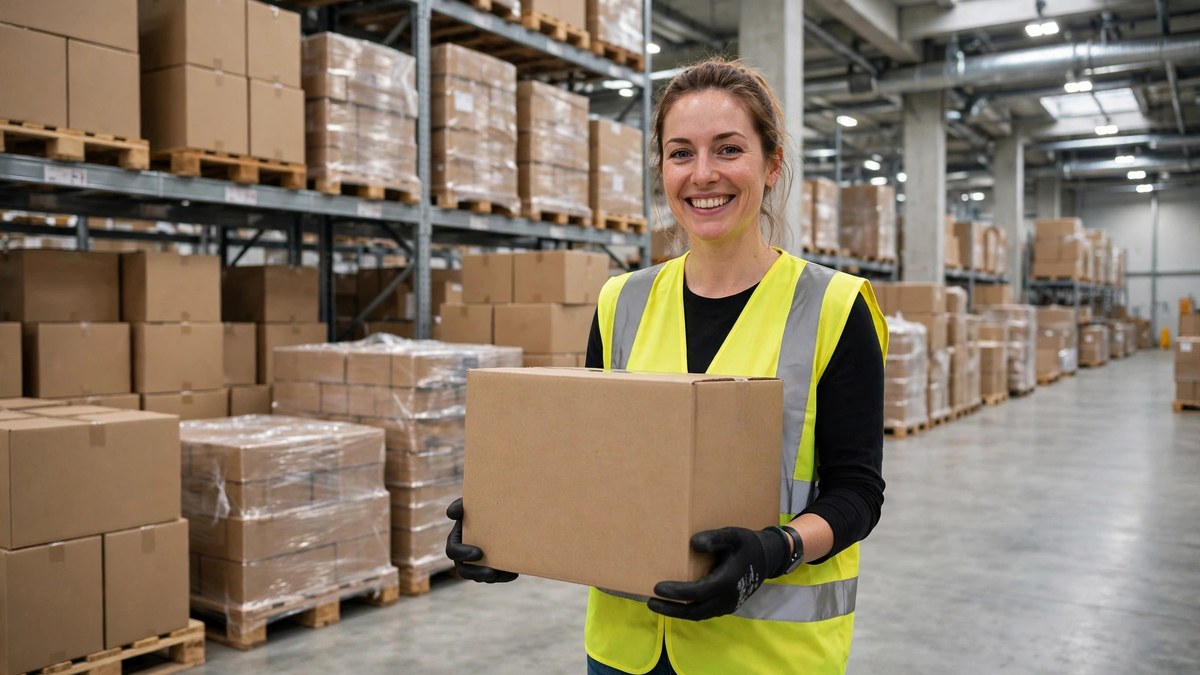
A modern American warehouse is a large, organised, and physically demanding workplace, and it helps to picture it clearly before you apply. Most warehouses are big rectangular buildings on the edge of a city, close to a highway or a rail line, with high ceilings, wide aisles, and rows of racking that can rise ten metres or more. Inside, the work is organised around a flow: goods arrive at the receiving dock, they are checked and put away on shelves, they are picked when an order comes in, they are packed at a packing station, and they leave through the shipping dock. Each step is a job, and each job has its own pace, its own tools, and its own risks.
A warehouse associate is the general role, and it covers receiving, picking, packing, and sorting. You may spend a morning unloading a truck, an afternoon picking orders with a handheld scanner, and an evening packing boxes for shipment. An order picker walks or rides through the aisles with a cart or a pallet jack, scanning each item and placing it in a tote. A packer stands at a station, wraps and boxes items, prints labels, and checks that the order is complete. A shipping and receiving clerk checks deliveries against paperwork, logs stock into the inventory system, and prepares outgoing shipments. A forklift operator drives a powered truck to move pallets, load and unload vehicles, and place stock on high racking. Each of these roles needs accuracy, because a wrong item in a box is a returned order and a lost customer.
Shifts in American warehouses are usually eight to twelve hours, and many warehouses run around the clock in two or three shifts. A day shift might run from 7 in the morning to 3 in the afternoon, an evening shift from 3 to 11, and a night shift from 11 to 7. Weekend work is common, and overtime is common in peak seasons, especially the holiday period from October to December, when e-commerce orders surge and warehouses hire extra staff. For an H-2B worker, the job is full time, at least 35 hours a week, because part time work does not qualify for H-2B certification. Expect to be on your feet for most of the shift, walking several kilometres a day, lifting boxes that can weigh 20 kilograms or more, and working in a building that can be hot in summer and cold in winter, especially near the loading docks.
Safety is taken seriously, and it should be, because warehouses have real hazards: forklifts moving through aisles, pallets stacked high, conveyor belts, and heavy boxes. A good employer gives you safety training on your first days, provides personal protective equipment such as a high visibility vest, safety shoes, and gloves, and enforces rules about walkways, lifting technique, and reporting injuries. If an employer skips safety training or asks you to work without proper equipment, treat that as a warning sign about the employer as a whole, not just about safety.
Machines, Products and What You Handle
The machines you will use depend on the role, and learning them is part of becoming useful quickly. A handheld barcode scanner is the most common tool in any warehouse, and you will use it to confirm every pick, every pack, and every shipment. A pallet jack, manual or electric, moves pallets across the floor. A forklift, in its several forms, moves pallets to and from racking and vehicles, and driving one legally in the United States requires training and certification, which a good employer provides. Conveyor systems move totes between zones, and in larger facilities you may work alongside automated sorting equipment or robotic carts that bring shelves to a picking station. You do not need to know these machines before you apply, but you do need to be willing to learn them, and to follow the safety rules that go with each one.
What you handle depends on the warehouse. An e-commerce fulfillment center handles a huge range of consumer goods, from books and electronics to clothing and household items, and the work changes with every order. A grocery distribution warehouse handles food, including chilled and frozen goods, and the work is faster, colder, and more time sensitive, because food has expiry dates and temperature rules. A pharmaceutical distribution warehouse handles medicines and medical supplies, and the work is slower and more exact, because a mistake can affect a patient. A retail distribution center handles the stock for a chain of shops, and the work follows the retail calendar, with big peaks before holidays and sales events. A cold chain warehouse handles frozen food or temperature sensitive products, and you will work in cold rooms wearing insulated clothing.
For a foreign worker, the type of warehouse matters for sponsorship, because H-2B is built for temporary needs, and some warehouses have clearer temporary peaks than others. A warehouse that supports a seasonal business, such as holiday retail, summer outdoor goods, or a harvest related supply chain, can show a seasonal or peak load need more easily than a warehouse whose workload is flat all year. That is why the honest guides on this topic point to seasonal and peak hiring as the realistic entry point. A warehouse that needs fifty extra workers for the holiday peak can justify an H-2B petition. A warehouse that needs five permanent associates year round usually cannot, because the need is not temporary.
Pay and Benefits
Pay for warehouse work in the United States varies by state, by employer, by role, and by shift, and anyone who quotes a single number for the whole country is misleading you. Published guides on warehouse sponsorship in 2026 put typical hourly pay for general warehouse roles in a range around 18 to 24 dollars an hour, with forklift operators and experienced workers toward the upper end and general associates toward the lower end. Night shifts and overtime often pay a premium. That range is a guide, not a promise, and the exact figure that matters is the prevailing wage for the specific job in the specific location, which the employer must obtain from the Department of Labor before it can file an H-2B application. The prevailing wage is the legal floor for that job in that place, and the employer must pay at least that amount. If an offer quotes far below the local prevailing wage, or refuses to put the wage in writing, walk away.
For an H-2B worker, the employer must also follow the wage rules of the program, and the job order filed with the state workforce agency states the wage, the hours, and the conditions. The work is full time, and overtime beyond 40 hours a week is usually paid at time and a half under federal law, though the exact rules depend on the state and the employer. Some employers provide housing or help finding it, some provide transport to the site, and some offer meals during shifts, but none of these is guaranteed, and you should ask for every benefit in writing before you accept. A genuine offer letter states the wage, the hours, the start and end dates, the location, and any housing or transport arrangement, and it does not ask you to pay a fee to receive it.
Benefits beyond pay vary widely. Large employers often offer health insurance, paid time off, and retirement savings to permanent staff, but an H-2B worker on a short seasonal contract may receive a narrower package, and the exact benefits should be stated in the job order and the offer. Do not assume that a benefit mentioned in a general job advertisement applies to a sponsored temporary role. Ask, in writing, what health cover, sick leave, and paid time off are included, and keep the answer with your contract.
One cost that is often hidden is the cost of getting to the United States. Under H-2B rules, the employer must pay certain costs, and a worker should never have to pay a large recruitment fee to get the job. If a recruiter asks for thousands of dollars upfront, for a visa fee, a job placement fee, or a training certificate that only they can sell you, that is a scam until proven otherwise. The employer files the petition and pays the petition costs. You pay the visa application fee at the consulate and your own travel costs unless the employer has agreed otherwise, and those amounts are modest and documented, not a large cash payment to a stranger.
What Employers Ask For
Warehouse employers ask for a small number of things, and they ask for them consistently. Physical fitness comes first, because the work is standing, walking, lifting, and bending for a full shift. You do not need to be an athlete, but you do need to be able to lift boxes safely, stand for hours, and keep a steady pace without frequent breaks beyond the scheduled ones. If you have a medical condition that limits lifting or standing, be honest about it, because a warehouse is not a place where that can be hidden, and an injury on the job helps nobody.
Basic English is the second requirement, and it matters more than many applicants expect. You need enough English to understand safety instructions, to read labels and pick lists, to ask a supervisor a question, and to report a problem. You do not need fluent or academic English, and you do not need to write essays. You need clear, practical, workplace English. If your English is weak, practise the vocabulary of the warehouse before you apply: words for receiving, picking, packing, scanning, pallet, forklift, aisle, racking, shipment, damaged, and return. That small vocabulary, used confidently, will carry you through most of a shift.
Reliability is the third requirement, and employers value it above almost everything else. Warehouses run on schedules, and a worker who arrives on time, every shift, who follows instructions, and who finishes the shift without disappearing, is worth more than a faster worker who is absent twice a week. Your application should show reliability: steady work history, references who will confirm that you show up and work hard, and a clear record of previous jobs held for a reasonable time. Short, unexplained gaps and frequent job changes are not fatal, but they invite questions, so be ready to explain them honestly.
Experience helps, but it is not always required for a general associate role. Many warehouses train new workers on the job, and they expect a new starter to need a week or two to reach full speed. Experience matters more for forklift operators, who need a licence or certification, for inventory roles, which need accuracy with systems, and for supervisory roles, which need proven experience managing people. If you have forklift experience, keep your certificate and be ready to show it. If you have experience with warehouse management systems or barcode scanners, name the systems you used. Specific experience, named clearly, beats a vague claim of warehouse experience every time.
Finally, employers ask for documents, and they check them. A valid passport, a clean record where required, and the ability to pass any background or drug screening the employer requires are part of the process for many warehouse jobs. Be honest on every form. A false statement on an application can end a visa process that would otherwise have succeeded, and it can create problems for future applications as well.
Documents You Will Need
Before you apply, gather the documents that every genuine process will ask for, so that you are ready when an opportunity appears. The list is short, but each item matters. You need a valid passport with enough validity to cover the job and the travel. You need a curriculum vitae that lists your work history, your duties, your employers, and your dates of employment, written in clear English. You need references from previous employers who can confirm your work, ideally with a phone number or email address where they can be reached. You need any certificates you hold, such as a forklift licence, a safety training certificate, or a first aid certificate, with the original and a clear copy.
For the visa process itself, the employer handles the labour certification and the petition, but you will need to attend a visa interview at a United States embassy or consulate, and you will need the petition approval notice, your passport, your application forms, and evidence of your ties to your home country, because an H-2B visa is a temporary visa and the consulate will want to see that you intend to return when the job ends. Prepare a simple, honest account of your plan: the job, the employer, the dates, and your return. Do not invent property, family, or employment that you do not have, because consular officers are trained to spot it, and a false statement can lead to a refusal that follows you.
Keep copies of everything you submit, and keep every notice, every email, and every receipt in one folder, physical or digital. If a recruiter or an employer asks you to hand over your original passport and keep it, refuse. No genuine employer needs to hold your passport. You show it, they copy it, and you keep the original. An employer who keeps a worker passport is a serious warning sign, and it is one of the indicators of labour exploitation that the Department of Labor warns about.
Visa Sponsorship Explained Honestly
This is the section that matters most, so read it slowly. The H-2B program has an annual cap of 66,000 visas, and that cap is divided between the two halves of the fiscal year. For the first half of fiscal year 2027, USCIS announced that it had received enough petitions to meet the cap by 4 September 2026, and it would reject new cap subject petitions received after that date for employment starting before 1 April 2027. That single fact tells you how competitive the program is, and why timing matters so much. An employer that starts the process late, or a worker who applies late, can miss the cap entirely, through no fault of their own. Apply early, and ask the employer when it plans to file, because the filing date can decide the outcome.
The H-2B process has three stages, and the employer drives all of them. First, the employer obtains a prevailing wage determination from the National Prevailing Wage Center, at least 60 days before the determination is needed. Second, the employer files a job order with the state workforce agency and an H-2B application with the Department of Labor, 75 to 90 days before the date of need, and recruits United States workers for the job. Only if that recruitment fails to find enough qualified United States workers can the Department of Labor certify the need. Third, the employer files Form I-129 with USCIS, and if the petition is approved, the worker applies for the visa at a consulate. The whole process takes months, which is why genuine H-2B recruitment for a holiday peak starts in the spring or summer, not in November.
That timeline is the best test of whether an opportunity is real. If someone offers you a warehouse job starting next month, with sponsorship, and asks for a fee today, the timeline does not fit, because a real H-2B petition cannot be prepared, certified, and approved in a few weeks. If someone offers you a permanent, year round warehouse job with H-2B sponsorship, the visa does not fit, because H-2B is for temporary need. If someone says Amazon will sponsor you directly as a warehouse associate through its careers page, the employer does not fit, because large employers fill associate roles locally and state clearly in many postings that the role needs work authorisation without sponsorship. The realistic sponsored roles are seasonal and peak roles, often filled through authorised recruitment agencies that work with the employer, not through the main careers portal.
The table below compares the three visa routes that are relevant to warehouse work, so you can see at a glance which one fits which role. It is based on the official program descriptions published by the Department of Labor and USCIS, and on the published guides that track these programs.
H-2B, temporary nonagricultural worker: covers general warehouse associates, forklift operators, order pickers, packers, and shipping and receiving clerks, for seasonal, peak load, or one time needs. Annual cap 66,000. No direct path to a green card. Stay is limited to the temporary need, usually months, and the worker returns home when it ends. EB-3, employment based green card, other workers and skilled workers: covers warehouse supervisors, inventory control specialists, and logistics coordinators with two or more years of training or experience. No annual lottery, but a visa number wait that depends on nationality and can be long. Leads to permanent residence. H-1B, specialty occupation: covers distribution center managers, supply chain directors, and logistics operations directors whose roles need a bachelor degree in a relevant field. Annual cap 85,000 with a lottery. Not a route for general warehouse work.
One more honest point. If you are already in the United States with valid work authorisation, through a student visa with Optional Practical Training, a green card, asylum, or another work permit, warehouse jobs are widely available to you right now, without sponsorship, and you should apply directly to employers. Many of the warehouse jobs advertised online are written for people who already have the right to work. Sponsorship is the exception, and it is aimed at the narrow situations described above. Knowing which group you are in will save you months of wasted applications.
How to Apply
Apply through the right channel, and the right channel depends on the visa route. For H-2B seasonal roles, the realistic channel is an authorised recruitment agency that works with a United States employer, or a direct application to an employer that has publicly advertised H-2B positions and holds a valid temporary labour certification. Ask for the certification number, the job order number, and the name of the employer, and check that the job order exists with the state workforce agency. A genuine recruiter will give you these details willingly. A scammer will change the subject.
For EB-3 supervisory roles, apply directly to the employer, through its careers page or a reputable job board. USA Warehouse Jobs with Visa Sponsorship 2026 listings for supervisors should state the experience requirement clearly, so check that your background matches before you apply. Your curriculum vitae should prove the two years of training or experience, with named employers, dates, and duties. For H-1B management roles, the same direct route applies, and your degree and your management experience are the core of the application.
Whatever the route, prepare a strong, honest application. Write your curriculum vitae in clear English, with your most recent job first, your duties described in plain verbs, and your achievements stated as facts. Tailor it to the warehouse: highlight picking, packing, scanning, forklift work, inventory, and safety training, and leave out unrelated detail. Write a short cover note that names the role, the employer, and why you fit it, in your own words. Do not use a generic letter that could have been sent to any employer, because recruiters can tell, and it signals that you are applying everywhere rather than aiming at this job.
Apply early. For a holiday peak starting in October, applications and recruitment often begin in the spring. For a summer peak, recruitment begins in the winter. If you apply in the month the job starts, you are almost certainly too late for a sponsored role, even if the job is still advertised for local workers. Put the seasonal calendar in your planning: decide which peak you are aiming for, and start your applications six months before it.
How to Spot and Avoid Scams
Warehouse sponsorship is one of the most scammed job areas in the world, because the demand is huge and the supply of real sponsored jobs is small. Scammers fill that gap with promises. Learn their patterns, and you will be protected.
The first pattern is a fee for the job. A genuine employer does not charge you to apply, to be interviewed, or to receive an offer letter. A recruiter who asks for a placement fee, a visa processing fee paid to them in cash, or a training fee for a certificate only they can issue is almost certainly a scammer. The employer pays the petition costs. You pay the consular visa fee, at the consulate, with a receipt, and your own travel. Any other large payment, especially by wire transfer, cryptocurrency, or gift card, is a fraud.
The second pattern is a guaranteed visa. No employer and no agent can guarantee a visa, because the decision belongs to the United States government, first to the Department of Labor, then to USCIS, then to the consulate. Anyone who guarantees approval, or who says the visa is already arranged, is lying. A genuine offer says the employer will petition on your behalf, and that the outcome depends on the government.
The third pattern is a job offer without an interview, a job order, or a named employer. A real offer names the employer, the location, the wage, the hours, and the dates, and it comes after an interview and a document check. An offer that arrives by message, from a stranger, with no interview and no details, is not an offer. It is bait. Ask for the employer name, the job order number, and the labour certification details, and check them. If the person refuses or disappears, you have your answer.
The fourth pattern is pressure. Scammers create urgency: pay today or lose the place, send the fee in an hour or the offer expires, do not tell anyone about this opportunity. Genuine recruitment is slow, documented, and patient, because the government process itself takes months. Pressure is a tactic, and the correct response is to stop, check the details, and talk to someone you trust before you send anything.
If you believe you have been targeted by a scam, stop all contact, do not send money, keep copies of every message, and report it to the authorities in your country and to the United States embassy. Reporting helps protect the next person, and it costs you nothing.
Life and Working in the USA
Life as a warehouse worker in the United States is practical, structured, and physically tiring, and it helps to arrive with realistic expectations. Most warehouse workers live in rented accommodation near the site, often shared with colleagues to keep costs down, and they travel to work by car, by employer transport, or by public transport where it exists. American warehouses are often outside city centers, so check the transport options before you accept a job in a place you have never visited. A job with no transport and no nearby housing is a job that will cost you more than it pays.
The cost of living varies sharply by state. A wage that is comfortable in a small town in the Midwest may be tight in a large coastal city. Before you accept, look up the rent, the food, and the transport costs in the job location, and work out a simple monthly budget. If the numbers do not add up, the job is not right for you, however attractive the headline wage sounds. A sponsored job that leaves you unable to live decently is not a good opportunity, and a good employer will understand that question.
Outside work, warehouse towns in the United States are often quiet, with shops, parks, and community centers, and with large immigrant communities in many regions. You will meet workers from many countries, and the warehouse floor is often one of the most international workplaces in the country. Learn the local rules, respect your colleagues, and use your time off to rest, because the shifts are long and the work is physical. If your visa allows it and your employer agrees, use the time to learn new skills, such as forklift certification or inventory systems, because those skills are what move a worker from a general associate role into a supervisory role, and from a temporary visa into a longer term future.
What People Ask Before Applying
Can I get a USA warehouse job with visa sponsorship without experience?
For a general warehouse associate role under H-2B, prior experience is often not required, because the employer trains new workers on the job. What matters more is physical fitness, basic English, reliability, and the ability to pass the employer checks. For supervisory roles under EB-3, experience is required, usually two or more years. For management roles under H-1B, a degree and management experience are required. Match your application to the role that fits your background, and do not apply for a supervisory role with no experience.
Does Amazon sponsor warehouse workers from abroad?
For general fulfillment center and warehouse associate roles, large employers such as Amazon normally hire locally, and many of their postings state that the worker must be eligible to work in the United States without sponsorship. Sponsorship at such companies is normally reserved for highly skilled corporate and technical roles. Seasonal warehouse work with sponsorship usually comes through authorised H-2B recruitment for a specific peak need, not through the main careers portal. Apply through the channel that matches the visa route, and beware of anyone who claims to have a direct Amazon sponsorship for an associate role.
How long does the H-2B process take?
Months. The employer must obtain a prevailing wage determination at least 60 days before it is needed, file a job order and an H-2B application 75 to 90 days before the date of need, recruit United States workers, obtain a labour certification, and then file a petition with USCIS. After approval, the worker applies for a visa at a consulate. A realistic timeline from the start of recruitment to arrival is several months, which is why genuine recruitment for a seasonal peak starts long before the peak begins.
Can an H-2B warehouse job lead to a green card?
Not directly. H-2B is a temporary visa, and it does not lead to permanent residence by itself. A worker who performs well may be invited back for a future season, and may separately qualify for another route, such as an EB-3 petition for a supervisory role, but that is a separate process with its own requirements and its own wait. Do not accept an H-2B job on the promise that it will turn into a green card, because that promise is not how the program works.
What is the H-2B visa cap, and why does it matter?
The law caps H-2B visas at 66,000 per year, divided between the two halves of the fiscal year. When the cap is reached, USCIS rejects new cap subject petitions for that half year. For the first half of fiscal year 2027, the cap was reached by 4 September 2026, and new petitions for start dates before 1 April 2027 were rejected. The cap is the main reason why timing matters, and why an employer that files late can fail even when the job is genuine.
Do I have to pay a recruitment fee to get a sponsored warehouse job?
No. A genuine employer does not charge you for the job, the interview, or the offer letter, and the employer pays the petition costs. You pay the consular visa fee at the consulate and your own travel unless the employer has agreed otherwise. Any large upfront fee demanded by a recruiter, especially in cash or by wire transfer, is a strong sign of a scam.
Final Word
USA Warehouse Jobs with Visa Sponsorship 2026 are real, but they are narrow, seasonal, and competitive, and they reward the applicants who understand the system. The H-2B program is the realistic route for general warehouse work, the EB-3 program is the realistic route for supervisory work, and the H-1B program is the route for management, and each one has its own rules, its own timeline, and its own cap. The applicants who succeed are the ones who apply early, who aim at a genuine seasonal need, who prepare honest documents, who ask for the job order and the certification details, and who refuse to pay a fee for a promise. If that is you, start six months before the peak you are aiming for, prepare your passport and your curriculum vitae, practise the English of the warehouse floor, and apply through a channel you have checked. The work is hard, the shifts are long, and the visa is temporary, but for the right person at the right time, it is a genuine door into the American workforce, and it is worth pursuing properly.
Sources: U.S. Department of Labor, H-2B Temporary Non-agricultural Program, USCIS, H-2B Temporary Non-Agricultural Workers, UMOH, Warehouse Jobs in the USA With Visa Sponsorship in 2026, IFMOSA, Warehouse Jobs with Visa Sponsorship. This article is general information only and is not legal advice. Visa rules, caps, and fees change, so confirm the current details with the Department of Labor and USCIS before acting.