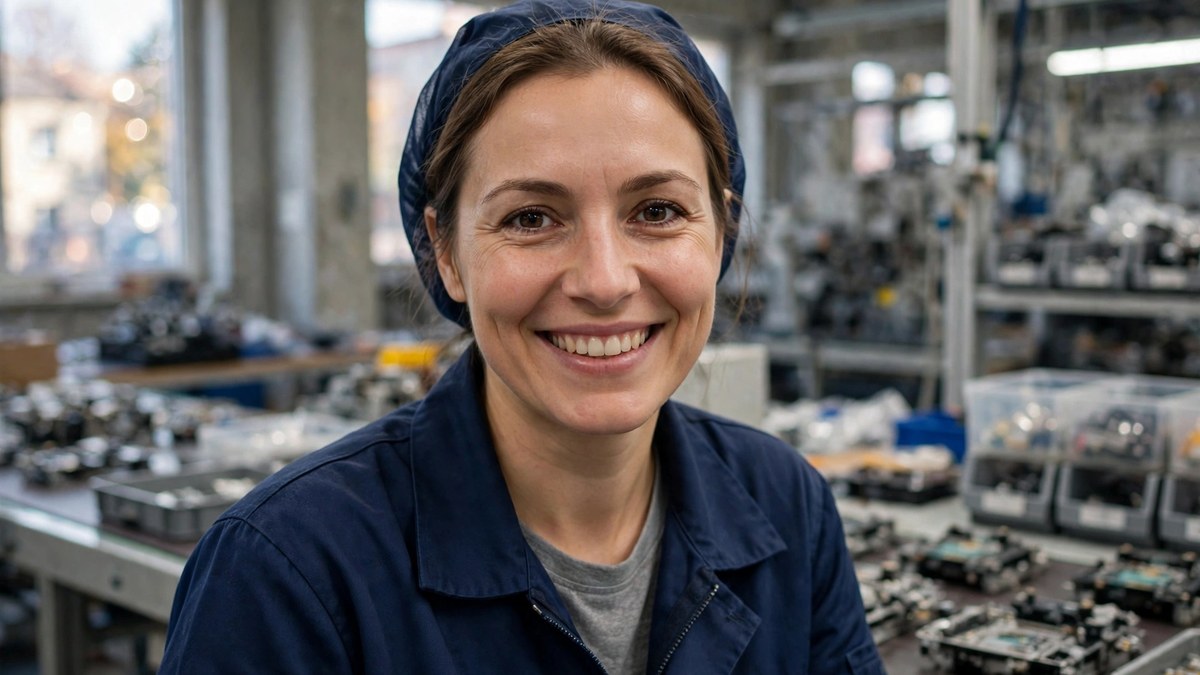
This guide lists the eight things a worker needs to know about poland factory assembly worker jobs with work permit support in 2026.
A factory hall in Poland is a long, bright building with a production line running down the middle. Parts arrive on one side, workers fit them together at stations along the line, and finished goods leave on the other side — electronics, car parts, furniture, household goods, packed and ready for shops across Europe. A factory assembly worker stands at one station, fits the same parts together, checks the quality, and passes the product on. It is indoor, physical, steady work, and Polish factories hire foreign workers for these roles through the year, with the employer applying for the work permit.
What changed for 2026 is not the production line itself. An assembly worker still fits parts, checks quality and packs finished goods. What changed is the hiring pattern around it. Factories in Poland hire all year, with peaks tied to orders, new contracts and production schedules. A worker who knows the eight things in this list — duties, cities, pay, safety, requirements, permit, accommodation and safe application — applies with a clear picture, to the right kind of factory, with the right documents ready.
Featured snippet answer: poland factory assembly worker jobs with work permit support in 2026 means a Polish factory offers a foreign worker an assembly job and supports the work permit. Pay is hourly and varies by city, factory and employer. A valid job offer is required first, and an employer never asks a worker to pay for it.
Key Takeaways
- A factory assembly worker fits parts together on a production line, checks quality and packs finished goods. The work is indoor, physical and steady.
- No degree is required. Hand skills, attention to detail, stamina and basic English or Polish matter more than a long CV.
- Factory assembly pay in Poland is usually hourly, with overtime and shift differences, and the exact wage is set by the employer and must be checked in the written offer. An assembly worker on a night shift in a plant near Warsaw can earn more per hour than one on a day shift elsewhere, so the offer should state the base rate, the shift pattern and the overtime rule together.
- The employer normally applies for the work permit in Poland, and the worker applies for a visa where required. Support is employer-led and never guaranteed.
1. What a Factory Assembly Worker Actually Does
A factory assembly worker fits parts together to make a finished product. Daily duties usually include fitting parts at a station on the production line, using hand tools and small machines, checking product quality, packing finished goods, labelling boxes, cleaning the work area, and following safety and quality rules. Workers may also sort parts, load materials onto the line, and report faults to a supervisor.
The work is organised in stages. Parts arrive, are fitted, are checked for quality, are packed, are labelled, and are stored for transport. A worker on the fitting stage needs steady hands and attention to detail. A worker on the quality stage needs a keen eye for damaged or wrongly fitted parts. A worker on the packing stage needs speed and accuracy with boxes and labels. A worker who thinks the job is only fitting parts will be surprised by the quality, packing and cleaning work, and by the safety rules that govern every stage.
The pace is set by the line, not by the worker. A new worker starts slowly, is trained, and moves to faster work as they learn. A worker who is fit, reliable and willing to learn will settle in fast. A worker who cannot stand for long shifts, or work at the pace of a line, will struggle, and should choose a different role.
2. Where the Work Is: Poland Factory Assembly Worker Jobs With Work Permit Support 2026 by City
Factory work is not spread evenly across Poland. Large factories are in Warsaw, Wrocław, Poznań, Łódź, Katowice, Gdańsk and Kraków, where electronics, car parts, furniture and household goods are made in large numbers. Those cities hire the most assembly workers. Work is also available in smaller towns, but the number of jobs is smaller, and the factory is often the main employer in the town.
A worker in a large factory works with a large team, a set shift and a fixed production line. A worker in a smaller factory works with a smaller team, and often does more varied work, including fitting, packing, quality checking and cleaning. The choice between a large factory and a small factory is a choice between pace, variety and location. A worker who wants the most hours should look at large factories, where production runs all year. A worker who wants varied work should look at smaller factories, where one worker does more tasks.
Factories are often in industrial areas outside the city centre, and many employers provide transport or help with housing. A worker should ask about transport in writing before signing, and should check how to get to the factory on public transport if no bus is provided.
3. Pay: How a Factory Assembly Worker Is Paid in Poland
Poland factory assembly worker pay is not one number. It is a structure, with four parts: the hourly wage, the hours, the shift, and the benefits. Pay is usually hourly in Poland, with overtime available in many factories. The hourly wage varies by city, factory and employer. An assembly worker in a large factory in Warsaw or Wrocław often earns more per hour than an assembly worker in a small factory in a small town, because the city, the factory and the demand for staff are different.
Hours are usually full-time, with shifts including mornings, afternoons and nights, because many factories run around the clock. Night and weekend shifts often pay more than standard hours. Overtime is common when orders are large, and it must be in the written offer, not in a message from an agent. Some employers offer health cover, paid holidays and bonuses after a qualifying period. None of these are standard for every factory job, and none should be assumed.
The practical step is simple for factory assembly in Poland: ask for the wage, the hours, the shift pattern, the overtime rule, and any benefits, in the written job offer. If an employer will not put those in writing, that is a warning sign, and the worker should walk away, because a plant that hides its terms before hiring will not improve them after the first shift.
4. Safety First: Machines, Protective Equipment and Factory Rules
Safety is not optional in a factory. It is the first rule, and it is checked every day. An assembly worker wears safety shoes, gloves and eye protection where required, provided by the employer. A worker follows the factory safety rules, uses tools and machines only as trained, reports hazards at once, and never works on a machine without the correct training.
Most employers provide safety training before a worker starts, and many provide ongoing training during employment. A worker who has completed basic safety training will be hired faster, but it is not always required before applying. A worker who ignores safety rules, skips protective equipment or works on a machine without training will be removed from the factory, and may lose the job.
The factory is also organised by area. Some areas are quiet assembly halls. Some areas are louder, with machines and forklifts. Some areas are warehouses, where goods are stored and loaded. A worker may stay in one area, or move between areas, depending on the factory and the shift. The common thread is safety. Protective equipment is provided. Hands are washed often. Machines are checked on a schedule. A worker who follows safety rules keeps the factory safe, and keeps the job.
5. Requirements: What a Factory Assembly Worker Needs
A factory assembly worker needs hand skills, attention to detail, physical fitness and reliability. Hand skills mean fitting small parts, using hand tools, and working with care. Attention to detail means noticing a wrong part, a damaged piece or a bad fit that a customer would notice. Physical fitness means standing, bending and lifting for long shifts. Reliability means turning up on time, finishing the task, and following safety and quality rules.
Basic English is useful, to understand safety instructions and supervisor directions, and basic Polish helps on the factory floor and in daily life. Many factories have supervisors who speak English, and many provide Polish lessons or help with the language. A worker who learns even a little Polish will settle in faster, in the factory and outside it.
Documents are simple, and they must be ready before the permit step: a valid passport, a job offer letter, proof of any relevant experience, and the visa documents requested by the Polish embassy where a visa is required. Keep copies of everything and never send original passports to an agent. A valid job offer from a Polish employer is normally required before any work-permit step.
6. Work Permit: How Support Works for Factory Workers in Poland
In Poland, the employer normally applies for the work permit. The usual order is: first, the employer offers the job in writing; second, the employer applies for the work permit with the voivodeship office; third, after the permit is issued, the worker applies for a visa at the Polish embassy where a visa is required; fourth, the worker travels and starts work. The exact steps and timelines change, and the worker should check the current rules on the official praca.gov.pl website and with the voivodeship office, and with the Polish embassy, before applying. This site does not provide immigration advice.
Work-permit support is employer-led and never guaranteed. It depends on the employer, the role and permit availability. A genuine employer will name the permit route in the offer, and will not ask the worker to pay for it. A worker should never travel without a valid visa where one is required, on the promise that the visa will be arranged after arrival. A worker should never pay an agent for a guaranteed work permit. No agent can guarantee a permit, a timeline or an approval.
A worker should also check the permit type, the employer named on it, and the dates. A work permit in Poland is normally tied to a specific employer and a specific job. If the employer or the job changes, the permit may need to change too. That detail must be checked with the employer and the voivodeship office, in writing, before signing anything.
7. Accommodation, Transport and Meals
Factory jobs in Poland with accommodation is a question every worker should ask, in writing, before signing. Some factories, especially in smaller towns and industrial areas, offer staff accommodation or help finding housing. Many city factories do not. A worker who needs accommodation should ask four questions, in writing, before signing anything: Is accommodation provided? Where is it, and is it shared? What does it cost, and is any cost deducted from pay? How long is it provided for?
The same rule applies to transport and meals. Transport to an industrial area is often provided by a company bus, and sometimes not. A meal or a meal allowance is sometimes provided, and sometimes not. A uniform and safety equipment are usually provided, and the worker should check. None of these should be assumed, and none should be agreed by message alone. Get them in the written offer, and keep a copy.
8. How to Apply Safely, and How to Move Up
First, search factory career pages and official job boards, including praca.gov.pl. Second, apply only through the employer’s official application link. Third, never pay for a job offer. A genuine employer will not ask for payment for a work permit or for sponsorship through WhatsApp, Telegram or unofficial agents. Fourth, keep a copy of the job offer and check the employer’s details, wage, hours and benefits before signing anything. Fifth, check the work-permit rules on the official praca.gov.pl website and with the Polish embassy, and do not travel without a valid visa where one is required.
A worker can move up. With experience, training and good English or Polish, an assembly worker can move into machine operator, quality checker, team leader and supervisor roles. Many supervisors started on the production line. The step takes time, and it takes training, but it is a real path, and it is open to workers who learn, stay reliable and ask for training.
Factory Assembly vs Warehouse Packing Poland: Which Indoor Job Fits You
A factory assembly worker fits parts together on a production line, with a fixed station, a set pace and quality checks. A warehouse packing worker picks, packs and loads goods in a warehouse, with a scanner, a team and varied goods. Both are indoor, physical, full-time jobs, with shifts including nights and weekends. Both can lead into supervisor and machine operator roles.
A worker who prefers fitting parts, a fixed station and a production line will suit assembly work. A worker who prefers varied goods, a warehouse and a scanner will suit warehouse packing. A worker who cannot stand at one station for long hours should choose warehouse work instead. The choice is about working conditions, not about which job is better.
Honest Limitations and Where to Verify Officially
This guide is general information only. It is not a job offer, and it is not immigration advice. It does not list a specific factory, a specific wage or a specific work-permit approval, because those depend on the factory, the city, the season and the worker’s own situation. Pay varies. Hours vary. Work-permit support is never guaranteed. Permit rules and timelines change every year.
Verify every detail with the employer, in writing, and with official sources: the praca.gov.pl website and the voivodeship office for work-permit rules, the Polish embassy for visa rules, and the employer’s own website for the job itself. If a detail cannot be verified on those sources, do not act on it.
Bottom line: Factory assembly is indoor, physical and steady work, with full-time hours and a real path to machine operator and supervisor roles. Apply early, get the offer in writing, check safety and pay in the contract, and never pay an agent for a job or a work permit.
Key Takeaways
- A factory assembly worker fits parts, checks quality and packs finished goods, on a production line, in a factory hall.
- Large factories are in Warsaw, Wrocław, Poznań, Łódź, Katowice, Gdańsk and Kraków. Large cities offer the most hours.
- Pay is a structure — wage, hours, shift and benefits — and it varies by city, factory and employer. Check it in the written offer.
- Safety is the first rule. Protective equipment, training and factory rules are provided, and the worker must follow them.
- The employer normally applies for the work permit, and the worker applies for a visa where required. Support is employer-led and never guaranteed.
- An assembly worker can move into machine operator, quality checker, team leader and supervisor roles with experience and training.
FAQ
Do Poland factory assembly worker jobs offer work permit support in 2026?
Yes, many Polish factories support foreign assembly workers, with the employer normally applying for the work permit and the worker applying for a visa where required. Support depends on the employer and permit availability, and it is not guaranteed for every role.
Do I need experience for a factory assembly job?
Experience helps, but many assembly jobs are entry-level and provide training. Hand skills, attention to detail, fitness and reliability matter more than a long CV for entry-level roles.
Is factory assembly work dangerous?
Factory work carries risks, and safety rules are strict. Protective equipment, training and factory rules are provided, and a worker who follows them works safely. Never work on a machine without the correct training. For a closer look at a similar route, see our guide to construction worker jobs in Poland.
What is the difference between assembly work and warehouse packing?
An assembly worker fits parts together on a production line, at a fixed station. A warehouse packing worker picks, packs and loads varied goods in a warehouse, with a scanner and a team.
Is accommodation provided for factory workers in Poland?
Some factories, especially in smaller towns and industrial areas, offer staff accommodation or help finding housing. Many city factories do not. Ask the employer in writing before travelling.
Can a factory assembly worker move up?
Yes, assembly workers can move into machine operator, quality checker, team leader and supervisor roles with experience, training and good English or Polish.